
Jackson County Previous Residents by Era
Previous residents research in Jackson County changes with the time period. A deed chain identifies recorded ownership and the legal geography of the parcel. Directories and census records can add a dated household clue, while maps, permits, probate, and an address index fill different gaps. No one source establishes every person who lived at a property. The right approach preserves the source date, the address form, and the parcel or legal-description link before moving back another step.
| Source | Years | Where Held | What It Shows |
|---|---|---|---|
| Deed books and direct/indirect indexes | 1853-1966 | Clerk Recording, archives, and storage holdings | Grantor, grantee, dates, legal description, consideration, and volume/page. |
| Official Records and DRR | 1966 onward; routine name search after January 1, 1984 | Clerk Digital Research Room and Recording counter | Recorded documents and party, instrument, date, type, or volume/page paths. |
| PDO deed and sales history | Deed-record clues from 2002-present | Jackson County Property Data Online | Current parcel context and a deed-card or recording-reference lead. |
| Southern Oregon directories | Selected editions, 1863-1932 | Truwe, JCLS, RVGS, and scan routes | Dated name, business, residence, or route clues, depending on the edition. |
| JCLS Sanborn maps | 1884-1927 locally; Ashland and Medford later holdings through 1952 | JCLS microfilm and County storage | Building footprint, block, street label, and use context, not a resident list. |
| Federal and territorial census material | Federal releases through 1950; local 1853-59 material | Official census sources, State Archives, and local repositories | Household evidence for a dated census, with territorial records kept distinct. |
| SOHS Address Index | Historical source pointers, dates vary | SOHS online index and research library | Title, address, city, source, property, and historic-address leads. |
For a recent transfer, begin with PDO and the Clerk. When the trail reaches an older instrument, retain the volume/page or instrument number before the ordinary online party search boundary is reached. For a household question, move out of the ownership chain and into the directory, census, obituary, and probate layers for the relevant date. That separation keeps a property record from being presented as proof of who lived in the house.
Note: The current owner, a tax mailing contact, and a dated household are separate kinds of evidence.
Jackson County DRR Search Break
The Jackson County Digital Research Room provides an online recorded-document route, but its ordinary party and document searching begins after January 1, 1984. The documented fields include name, instrument number, document date, document type, and volume/page. Before 1984, the online path is instrument number or volume/page. The Clerk's direct and indirect deed-index volumes reach 1853, making the Recording counter and historic holdings part of a real address trail rather than a last resort.
The public DRR acceptance screen precedes a Jackson County previous residents deed search.
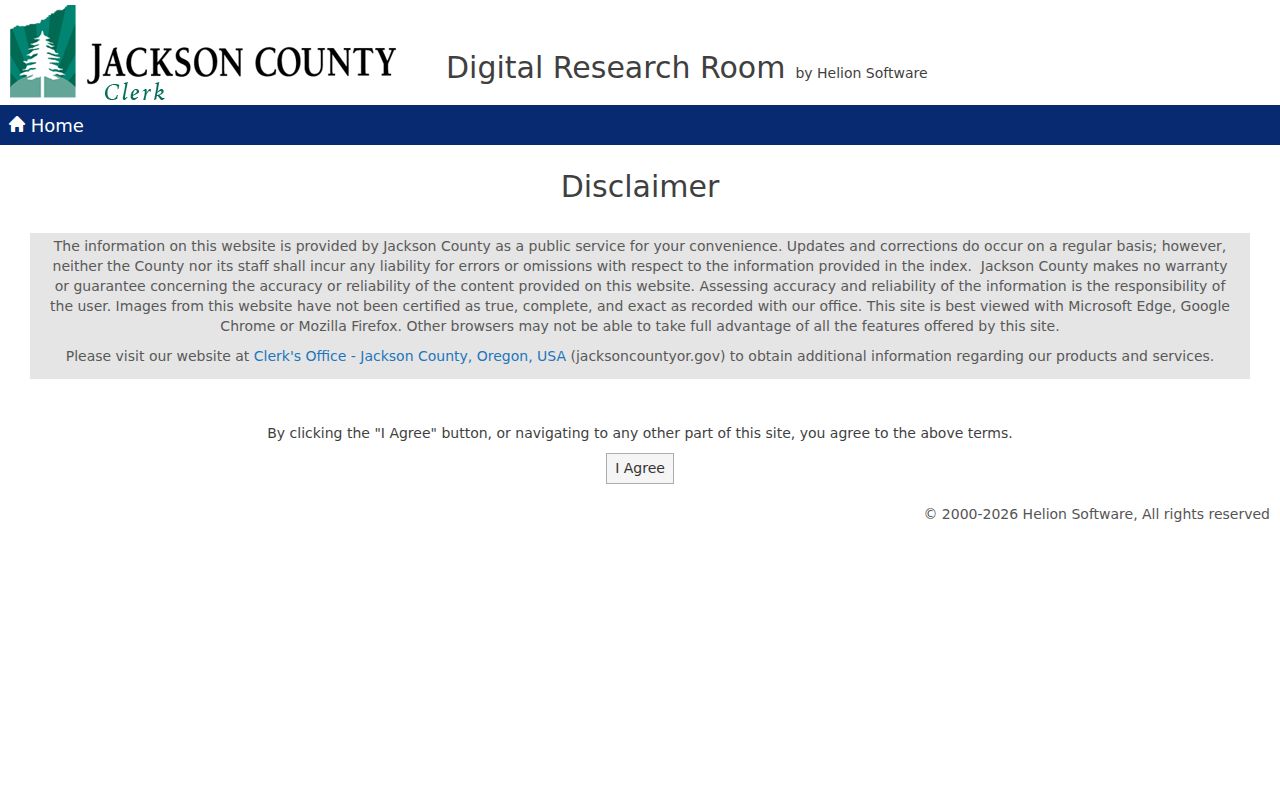
A document image in DRR is not certified, according to the County's visible disclaimer, so a certified copy follows the Clerk's processing route.
Jackson County's recorded-document instructions identify deeds, mortgages, reconveyances, liens, releases, easements, affidavits, powers of attorney, and other instruments. Free watermarked viewing is described for ownership deeds, while other download arrangements may be paid and certified copies are manually processed and mailed. The Clerk says it does not perform title searches. Build the sequence from the index and source documents instead of asking staff to decide the chain.
PDO Clues for Past Residents
Insider tip: A street-address search in Jackson County Property Data Online can supply the current account context and a sales or deed-card clue before a researcher enters DRR. PDO's documented assessment-year selector runs from 2002 through 2026. Its address, owner, account, map/taxlot, subdivision, sales-study, and clerk-inquiry routes are useful for finding the parcel and reference, but they do not replace a historic deed index.
PDO separates Fee Owner, Contract, In Care Of, Mailing Address, and site-address fields. A mailing address is the tax-notice destination and may be an agent, trust, business, post-office box, or another residence. It is not proof that the listed party occupied the situs. Likewise, the site address can be occupied by a renter or another household member who never appears on the tax roll. Use the account as a starting point, not as a list of past residents.
Use the reference, not the label. Carry the map/taxlot, account, and legal description from PDO into the deed search. They are stronger continuity markers than a mailing address or a changing street expression.
Trace Jackson County Deed Chains
A chain of title follows the transfer of a particular legal interest backward. Start with the current parcel, not a name alone. Use PDO's sales/deed-card information to find the newest recorded instrument in DRR or at the Recording counter. The grantee, or buyer, on one deed is the later owner. The grantor, or seller, is then searched as a grantee to locate the earlier acquisition. Each link needs its own document date, recording reference, parties, and legal description.
- Find the current PDO property account and preserve the site address, map/taxlot, account, and legal-description reference.
- Open the most recent sale or deed-card clue and retrieve the recorded instrument through DRR or the Clerk.
- Record the grantee, grantor, document and recording dates, instrument or volume/page, and legal description.
- Search the prior seller as grantee, then repeat while testing the legal description and parcel against each earlier deed.
- At the pre-1984 party-search boundary, use the volume/page or instrument route and consult the Clerk's direct and indirect deed indexes.
- When an older transfer covers a larger tract, find the partition, subdivision, or plat before assigning it to the present house lot.
- Grantor and grantee
- The grantor transfers an interest. The grantee receives it. In a backward search, the earlier seller is often the next grantee to locate.
- Chain of title
- A documented sequence of transfers for a property interest. It identifies ownership history, not automatically every resident.
- Legal description
- The deed's property description, such as a lot and block, metes and bounds, partition reference, or recorded deed reference. It is stronger than a street address for older records.
Jackson County Addresses Before Current Forms
Older Jackson County address material may not resemble a current street-address search. The County's Address Points service carries Current, Pending, and Retired statuses along with legacy street-name components. In Medford, historic material can call present Main Street "7th Street," and Southern Oregon Historical Society material preserves a 1908 alphabet-letter-to-horticultural street-name change. Jacksonville mining-era records, rural delivery language, Donation Land Claims, township/range, subdivisions, and old road descriptions can also be part of the property trail.
Do not force an older wording into a current postal address. Test the legal description, Assessor map/taxlot, and historic map first. The County inventory identifies road records back to 1852 and historical road-name-change files from 1958-1978 in storage. Those are contextual sources when a rural road label fails, but the research did not verify a Countywide street-renumbering year. A link must be demonstrated through the parcel and sources, not assumed from a similar street name.
Note: A historic street label can be a bridge to investigate, never by itself proof that two addresses are the same property.
SOHS House History for Jackson County
The Southern Oregon Historical Society Address Index is the strongest verified historical-address fallback when a directory or deed uses an unfamiliar form. It searches historical name and address fields and can limit by city. Its reported result columns are Title, Address, City, and Source. The index can point toward a property survey, historic title, road, building, Donation Land Claim, or township clue, but it does not present a complete reverse directory or prove every person who lived at the location.
The SOHS historical-address search is available from its Jackson County research index.
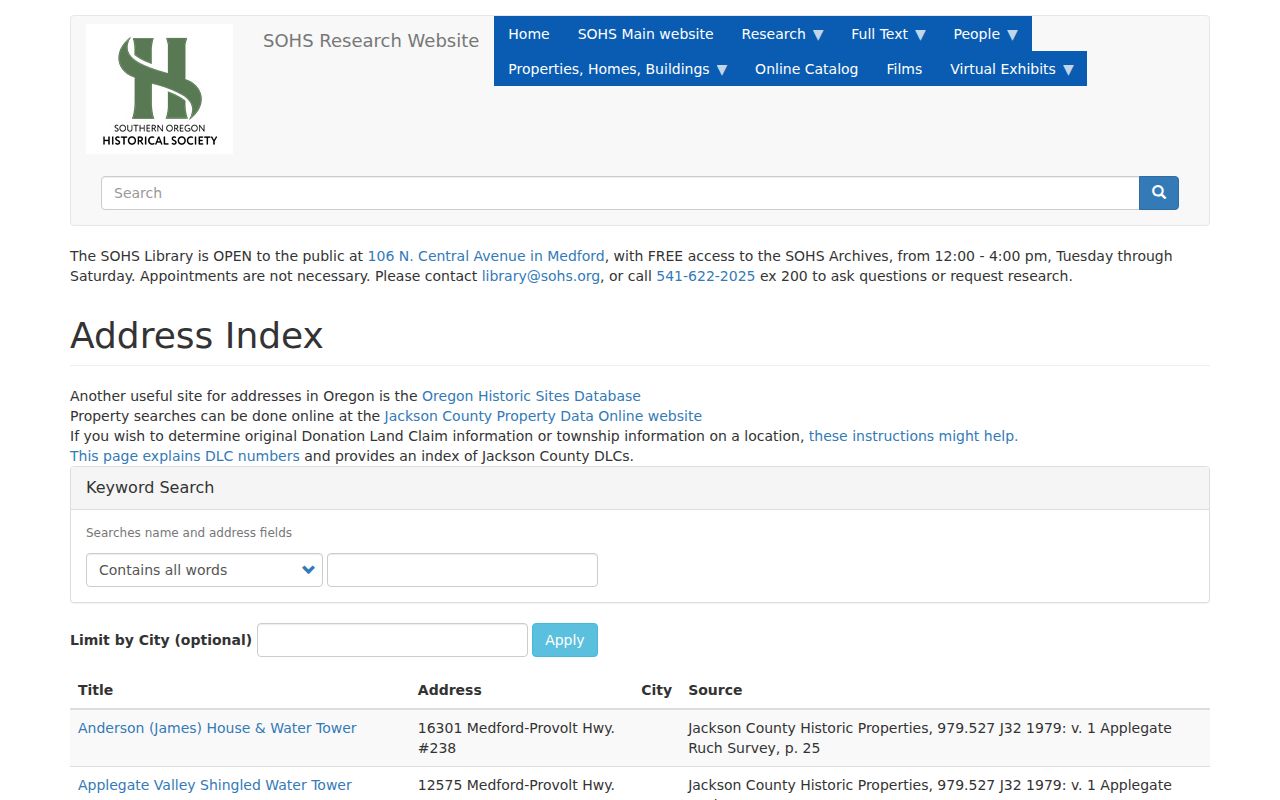
Use the optional city limiter and preserve the returned source title before requesting the underlying material.
SOHS's research library is at 106 North Central Avenue in Medford and is open from noon to 4:00 p.m. Tuesday through Saturday without appointment. The research file notes that its online catalog is incomplete. A no-result web query is therefore a reason to request legacy card-catalog or archival help through library@sohs.org or 541-622-2025 ext. 200, rather than a conclusion that a house has no history.
Past Residents: Directories and Census
Past owners and past households need different records. A Jackson County deed chain follows ownership, while a selected city or county directory can associate a name with a residence phrase, route, occupation, or business at one printed date. Federal census records can add a household snapshot for the census date. The historical collections themselves, their titles, and their gaps are detailed on the Jackson County city directory collections page. Neither a directory nor a census should be stretched beyond its printed or enumerated date.
The directory and census process is a simple date match: directory year to closest available census year to other local evidence.
- Choose the Jackson County, Medford, Ashland, Jacksonville, or Rogue Valley directory edition that fits the community and approximate year.
- Capture the exact spelling, initials, spouse name, occupation clue, and printed residence wording.
- Check a nearby edition to see whether the same name or address expression continues, changes, or disappears.
- Pair the dated entry with the closest public federal census release, or with the separate Jackson County territorial material for the 1850s.
- Use probate, obituary, cemetery, tax, or property-source evidence to test a move, death, estate event, or address continuity.
The digitized Southern Oregon runs include selected editions from 1863 to 1932, and the 1916 countywide directory reaches towns, villages, RFD areas, and star routes. The 1931-32 Medford Business Directory warns that subscription listings can produce gaps. A missing directory name therefore does not prove that a household left the property. It may reflect a selected year, an edition's scope, a spelling variation, or the listing method.
Lawful personal use. Use past-resident research for house history, family history, estate work, or documented community history. Do not use a dated record to track, stalk, harass, or harm a living person.
Jackson County Sanborn and Probate Clues
Sanborn maps date the physical property, not the people inside it. JCLS has local microfilm for Butte Falls, Central Point, Jacksonville, and Medford from 1884-1927, and Ashland from 1884-1928. Later Ashland and Medford holdings for 1927-1952 are listed in County contracted storage. A map can show a building footprint, block, street label, or use context. Pair it only with a directory, census, or other person-specific source from the relevant period.
The digitized Southern Oregon directory runs offer a dated starting point beside a map or census record.
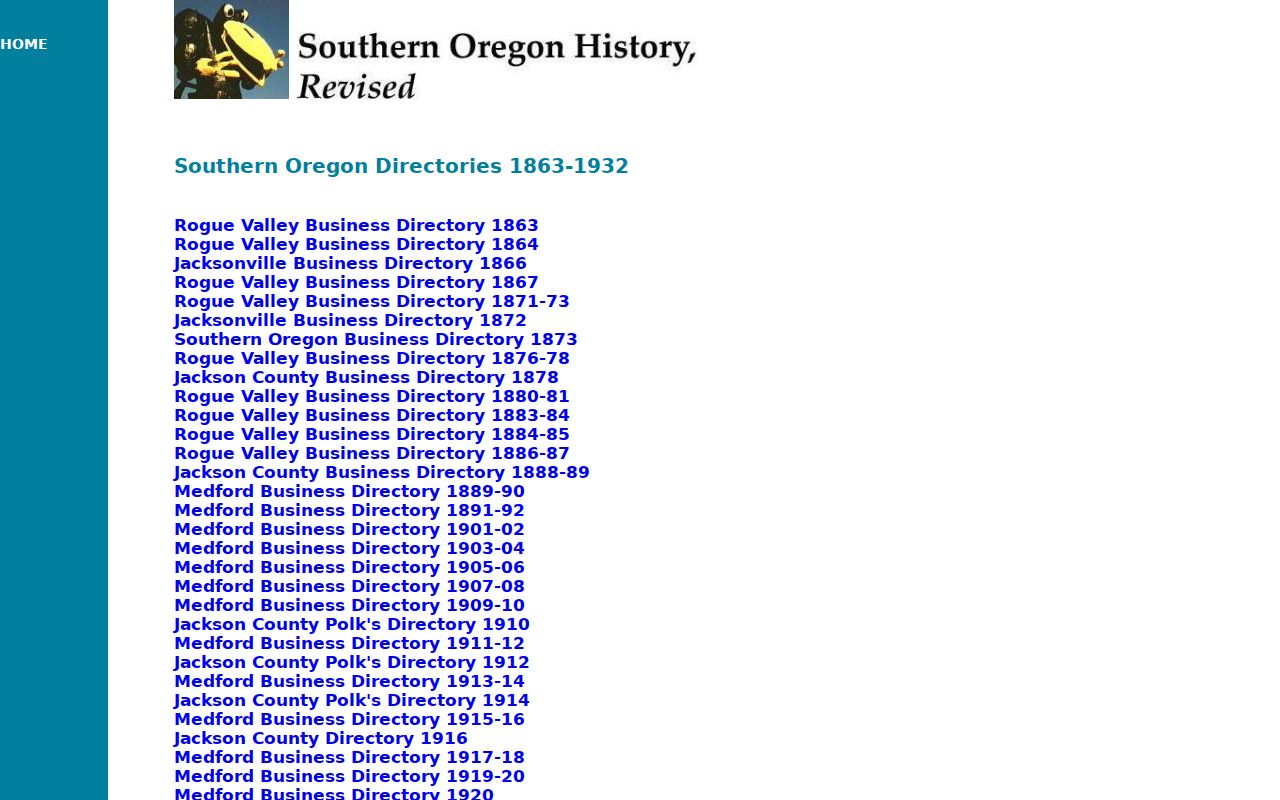
A selected directory edition can supply a name or residence clue, while the map supplies property context for the same historical period.
Probate and obituary material can close part of a trail after an owner or occupant dies. Jackson County's historic probate series begin in 1853, and the Oregon Historical Records Index lists Jackson County estate entries for 1853-1925. Estate files may identify a deceased person, executor or administrator, residence, heirs, and relationships. RVGS, JCLS, the State Archives, and court holdings provide different access channels. Treat probate as evidence about an estate event, not proof that every heir or named person lived at the property.